Rat Control
Rat Control in Your House and Garden
Norway rats are excellent climbers, jumpers, and swimmers. You can find them almost anywhere in the world: in the city or the countryside, from the sewers to the attic. It's not uncommon for them to nest in unwelcome places. Rats are intelligent, cautious animals with enormous adaptability, making rat control a significant challenge. Read everything about getting rid of rats in your house or garden here, or call SPOT today for a fast and expert solution!

Wat onze klanten te zeggen hebben
Get Professional Rat Control
Leave your details here, and we will call you back as soon as our next home visit is finished.
- We are happy to listen to your problem so we can discuss solutions.
- Get a clear idea of the costs immediately.
- Asking is free!
Contacteer ons
Informatie over rat control
Ecology of the Rat
Rat or mouse in the house?
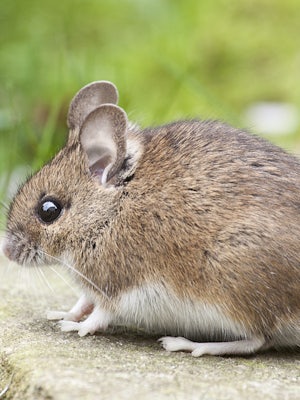
Are you unsure whether you have rats or mice in your house? Pay close attention to droppings and odor. The urine of brown rats smells like ammonia. Mouse urine also doesn't smell fresh, but "musty" would be a better description. If an animal's presence seems very mysterious, it might well be a rat. They generally operate more under the radar than a mouse, which is rather enthusiastic by nature.
Types of Rats
Norway rat
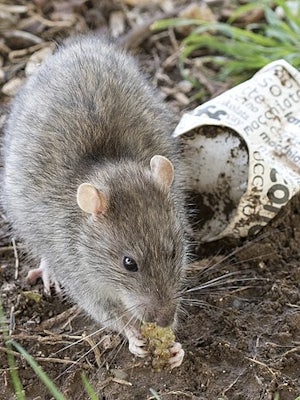
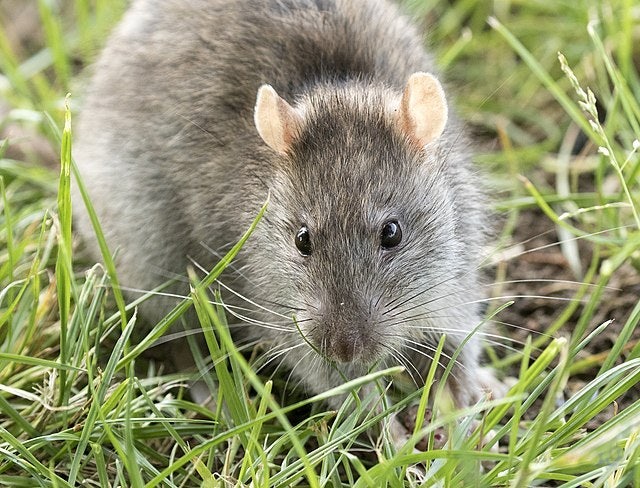
In 95% of cases, rat nuisance in Belgium is due to the brown rat (Rattus norvegicus). People often claim they have voles or muskrats, but these species names are too often used incorrectly. This is because the brown rat can live in very diverse places; in the sewer, for example. But you can find them just as easily on a farmyard, a railway embankment, or in a chicken coop.
Black Rat
The black rat (Rattus rattus) accounts for a smaller proportion of rat nuisance cases. It is also an extremely shy rodent, and a black rat is even harder to catch than a brown rat. Black rats like to live at height. In agricultural businesses, they can sometimes be found in the ceilings of stables, but black rats also occasionally enter residential homes. They usually choose the attic or a ceiling as their dwelling place. In English, this excellent climber is known as the "roof rat" for a reason. The black rat prefers warm places, so you won't likely encounter one in the winter.

Differences between the Brown and Black Rat
| Brown Rat | Black Rat |
| Larger body (sturdier) | Smaller (slimmer rear) |
| Larger head, small ears and eyes | Pointed snout, large ears and eyes |
| Gray, brown fur | Black to light brown, light fur on the belly |
| Tail: shorter than the body | Tail: longer than the body |
Muskrats and Voles
Muskrats are still found here and there in some watercourses in Belgium, but their numbers have been strongly reduced today. In the Netherlands, the Water Boards control the muskrat population to prevent foraging damage to dikes. Muskrats actually belong to the family Cricetidae (voles). Strictly speaking, they do not belong to the rat family. Voles also belong to this family. They are semi-aquatic animals. Densely vegetated banks are their favorite spot. Muskrats and voles are primarily vegetarians, so they have little to look for in buildings and gardens.
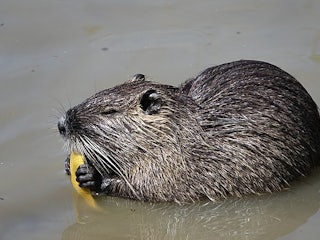

(Image: left: a muskrat, right: a vole)
Reproduction and Life Cycle
Brown rats can reproduce throughout the year. A female can give birth up to 5 times a year. A female is sexually mature after 5 weeks, and a pregnancy usually lasts 3 weeks. A litter consists of 7 to (maximum) 14 young. Do the math! Rats can live to be three to four years old, but in the wild, a rat is lucky if she even blows out one candle.
Traces and Droppings
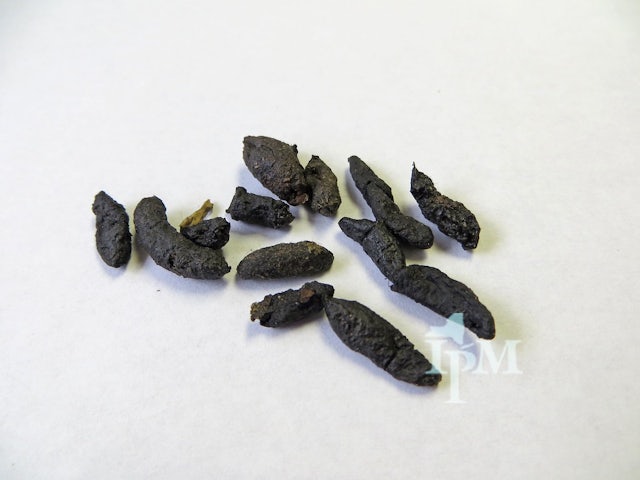
The most important signs of rat nuisance are droppings and urine. A mouse will leave droppings along its path, but a rat's droppings are usually found in a place close to the nest. As rodents, rats are also avid gnawers. Like all rodents, they must gnaw to wear down their teeth, which grow continuously, like human nails. Rat droppings (photo below) are about the size of a peanut, but a bit longer and slightly thinner. Mouse droppings look more like sprinkles.
Rats in the house: what to do?
It happens much more often than most people think: rats in the house. Rats have great adaptability and are always looking for food and a warm shelter. Especially when it gets colder outside, rats won't say no to a heated home with human food supplies. A small gap in a basement grate is sometimes quickly found. Or perhaps you should have pruned that climbing plant before it reached the tile roof?
What to do about rats in the house? Call SPOT, of course! But for the DIY enthusiasts among you, here are some preparatory steps to control rats in the house and tips on how to catch a rat nest in your house.
Step 1: Where did the intruder come from?
Before you do anything else, it's best to walk around the building and seal all places where rats can enter. For cracks, the opening should not be much larger than 1.5 cm, and for round openings, 2.5 cm (for a fully grown brown rat). When you're at the very bottom of the food chain, you'd better fit into small holes! With its whiskers, a rat immediately has a good gauge to assess whether it can get through an opening. Moreover, a rat can quickly gnaw through different materials to enlarge holes that are too small.
Also pay attention to the drains and sewers in the house. Sometimes the rats come from the sewer. Whether in the city or the countryside, a sewer is an attractive hiding place for a rat. Underground temperatures fluctuate less than above ground, so a rat is less cold at night.
Not sure where rodents can and cannot get in? Give us a call, and we'll assess it with an experienced eye!
Then try to limit climbability by removing or adding things and sealing openings. Steel wool is a simple and quick solution that rats don't like to gnaw on. Sealing openings seems counterintuitive, as many people shudder at the thought of trapping rodents in their house. However, this works best. This way, you take control of the situation. A wild animal doesn't just dance to your tune.
Step 2: Food
What else fits into this approach? Take more control of the situation before you start controlling the rats. You want to deprive the rat(s) of their main need: food. Store everything, down to the last crumb. Use hard materials such as plastic or metal boxes and glass. If you hide things in kitchen cabinets, make sure that rodents cannot get into the cabinet from the bottom or back.
Step 3: Catching
Are all openings sealed? Can no more rats get into or out of the building? Is all edible food neatly stored? Then read on here about how to exterminate or catch rats, or read everything about professional rat control here.
Rats in the Attic
When you have problems with rats in the attic, there is probably a way for them to easily climb up and enter. It's always a good idea to ensure that rodents cannot reach the roof level. A tiled roof is dense for rain (which comes from above), but not for rodents who exploit small gaps to enter the roof.
Besides being good swimmers, rats are primarily good climbers. So look for openings on the ground floor, but don't forget openings at height, as long as there is something that makes climbing easy: a climbing plant, a drainpipe, objects stacked against the wall, a hedge, a low-sloping roof, and so on.
Rats in the Garden
A rat infestation doesn't always occur in a building, of course. Often, a rat infestation arises in the garden, on industrial sites, in watercourses, etc. Rat nests in a chicken coop, for example, are unfortunately more the rule than the exception. Individuals regularly ask us if it's even possible to keep chickens without seeing rat holes in the yard. The presence of food for birds or other pets, large amounts of nuts (falling from the tree), garbage, pet food, and the warmth under a compost pile also often cause problems with rats in the garden. We often repeat ourselves, but the common thread throughout this story is invariably easily accessible food. A good hiding place is also high on a rat's wish list, but it will only look for one near a food source.
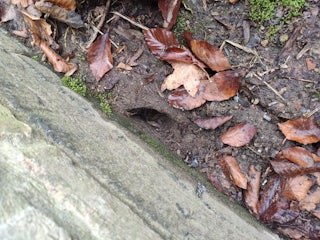
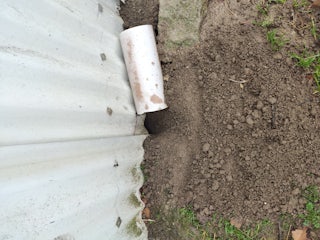
rat holes: a rat always keeps the opening clear to be able to escape quickly in case of emergency.
Repelling Rats in the Garden
Repelling rats in the garden is simultaneously one of the best and worst ideas there are. Let us explain. You plan to repel rats from your chickens without poison, for example, with scent, black pepper, or with ultrasonic sound. This is not a good idea. You should reverse the reasoning: why are the rats here? Because of the food, of course. So don't actively repel the rats, but don't attract them: take control of what makes them stay. Animals should ideally be fed in places where rats cannot reach the food. If you cannot limit the presence of food in the area, limit it in time: give animals small portions at different times, so that everything is immediately eaten and nothing is left over. If necessary, stay with them. Make no mistake: a rat is a nocturnal animal, but it will quickly understand that it must strike during the day if necessary. And if it has to, when you turn your back for five minutes.
Should I call the municipality?
We notice that many people have the idea that preventing rat nuisance is a task for the municipality. That is correct, as far as the problems occur on public property. On private property, rat control is a private matter. Some municipalities make exceptions to this. Where there is rat nuisance, food is often involved. And that is often found in gardens.
Rat Control
Controlling rats requires a good understanding of the psychology of this intelligent rodent. Moreover, it is good to know what working with traps and poison entails.
Exterminating Rats with Poison
When you are going to exterminate rats with poison, there are some important factors you need to consider. Because as with everything, there are advantages and disadvantages associated with this method.
When using rodenticide, you must be able to exclude both primary and secondary poisoning of non-target animals. This can apply to your or someone else's pets, but also to other wild animals. Primary poisoning is prevented by ensuring that other animals cannot directly access the poison. Secondary poisoning occurs when a predator (e.g., a house cat) eats a poisoned rat. This risk can be limited by the choice of product, the quantity, and the concentration of the poison. Read the instructions on the packaging carefully. Products for indoor use should only be used... indoors!
Toxic bait also has advantages: ease of use, for example. Multiple rats can eat from a bait point at the same time, without requiring maintenance or inspection. Traps can often only catch once and then require action from the user.
Rodenticides (poison for rodents) are often based on anticoagulants. This is a substance that hinders proper blood clotting. A rodent does not die immediately from this. So don't think: "I won't use a trap because I feel so bad for that little animal." In a rat trap, a rat is instantly dead, and it is therefore much more humane than poison.
Rodenticides are not miracle cures. Many people imagine that the factory knows the magic formula to make poison for rodents irresistible. Well, nothing could be further from the truth. A rat usually sticks to a food source it knows. Trying something new can only involve risk. Removing the titmouse balls is therefore probably a more efficient control method than placing a bait station with rat poison underneath.
Try to avoid rat poison indoors. A rat doesn't choose where it will die. A carcass in the ceiling happens quite often. Let the solution not be worse than the problem.
Catching Rats: Control Without Poison
How can you best catch rats? There are many traps. These include: live rat traps, snap traps, or even glue traps. It is best to avoid the latter, as they are not animal-friendly and often lead to bycatch, especially outdoors.
Live Rat Trap
Catching rats alive is best done with a live trap. But be warned: it's not easy. Rats are intelligent, and before you know it, they'll steal the bait from the cage without activating the closing mechanism. You should ask yourself beforehand what you will do when you have a catch.
Snap Trap
A snap trap is one of the most efficient and humane ways to catch a rat. Use a trap with the necessary precautions: prevent other animals from reaching it. Never leave an open trap set during the day. You might catch birds.

Glue Traps for Rats
Glue traps are a controversial pest control method. They are very inhumane and are therefore not allowed in Wallonia. It is often said that the animals die from a stress reaction, but you can certainly find them alive as well. Judge for yourself whether the circumstances justify their use. Avoid bycatch.
Bait to Catch Rats
What are rats attracted to? This is the first question people often ask when they want to catch a rat. But before you look for the best bait, you must eliminate all other food sources. In that case, almost any bait will work. But feel free to try peanut butter or a piece of melon.
The Psychology of Rats
A rat is an intelligent and cautious animal. It will not quickly try something new when it had a food source that was clearly trustworthy. So realize that you are asking the animal to take a risk. This sometimes takes time. Moreover, you can capitalize on this by implementing a habituation period: You feed them bait in or on the trap for a few days without activating it. This way, a rat will consider the bait and the trap harmless.
Are you dealing with multiple rats? Be sure to use enough traps; preferably more than there are rats. Once you start catching, a seasoned rat will quickly see through your cunning approach.
Rats also have a kinesthetic sense. They use their muscle memory and thus store their environment. Therefore, move traps or bait as little as possible during a control effort. All their senses are very strongly developed, except their sight. Rodents are practically blind.
Rat Control: what are the costs of a professional rat exterminator?
The price of rat control usually depends on several factors:
- The extent of the infestation
- Factors that make control more difficult (Are there pets? Will the control methods face much competition from other food that the rats can eat?)
- What are the safety requirements?
- Number of interventions
- The nature of the building
But with that, you still don't know what budget you should allocate for the work. At SPOT, you always get an immediate price indication over the phone. This way, you are never faced with surprises. Call us today with all your questions about rat control.